How an obscure survival doctrine became the counter-Islam crowd’s favourite lie
Someone posts it online like a trump card. A thread about Islam, a debate about Muslims, a comment section under a news article — and there it is. Taqiyya. Dropped with the confidence of someone who thinks they’ve just revealed the cheat code to an entire religion. “Muslims are allowed to lie to non-Muslims. It’s called taqiyya. Look it up.”
They haven’t looked it up. They’ve never read the verse. They couldn’t name the companion it was revealed for. They don’t know the conditions under which it applies or the scholarly consensus on its limits. They don’t know that most Sunni Muslims have barely encountered the term in their entire religious lives. But they’re confident. They saw it on a blog, or a YouTube video, or a thread by someone with a flag in their bio and a reading level that doesn’t extend past headlines.
This article is for them. And for the people they’ve misled.
Here is the first problem with their argument: the word itself. Taqiyya is a Shia jurisprudential term. It belongs to a specific tradition within Islam — the minority tradition, representing roughly ten percent of the world’s Muslims. The vast majority of Muslims are Sunni, and most Sunni Muslims have never used the word taqiyya in their lives. It does not appear in standard Sunni legal vocabulary. The Sunni concept that covers the same ground is called idtirar — compulsion — a broader legal principle that applies to any situation of extreme duress, from concealing one’s faith under threat of death to eating prohibited food to avoid starvation. It is not a doctrine. It is not a strategy. It is a recognition that God does not punish a person for what is forced out of them at the point of a blade.
So when someone accuses “Muslims” of practising “taqiyya,” they are using a term from one tradition to smear an entire religion of nearly two billion people — most of whom would not recognise the word if you said it to them. They have built an accusation on a term they do not understand, borrowed from a tradition they cannot identify, and applied it to a population that largely does not use it. That is the foundation their argument stands on. It is worth knowing how sturdy it is before we go any further.
Now. Let’s start with where the concept — whatever you call it — actually came from.
The Story of Ammar ibn Yasir
In the earliest days of Islam, in Makkah, the new faith had no army, no state, no political power. The first Muslims were overwhelmingly poor, enslaved, or socially vulnerable. The Quraysh — the dominant tribe of Makkah — did not debate them. They tortured them.
Among the first to accept Islam was a family with no tribal protection at all: Yasir ibn Amir, his wife Sumayyah bint Khayyat, and their son Ammar. They were slaves. They had no one to shield them. And when the Quraysh learned of their conversion, they made an example of them.
The family was dragged into the open under the scorching midday sun. They were beaten. They were stretched over burning sand. They were told the price of their faith was pain — and the price of relief was to renounce it.
Sumayyah refused. Abu Jahl — one of the most powerful men in Makkah and among the most vicious opponents of the Prophet — tortured her publicly. When she would not break, he killed her. She is recognised in Islamic tradition as the first martyr of Islam. Not a warrior. Not a general. A woman. An enslaved woman. Killed because she would not conceal her faith.
Yasir was killed as well.
Ammar survived — but not intact. The torture broke his body to the point where, as the sources record, he no longer knew what he was saying. Under unbearable duress, he spoke words against the Prophet and praised the Quraysh’s gods. They released him.
He went to the Prophet Muhammad, weeping. He was terrified — not of the Quraysh, but of God. Had he committed apostasy? Had the words forced from his broken body cost him his faith?
The Prophet asked him one question: “How do you find your heart?”
Ammar replied: “Firm in faith.”
The Prophet told him: “If they do it again, do the same.”
And then God revealed the verse:
“Whoever disbelieves in Allah after having believed — except one who is forced while his heart remains firm in faith — but those who open their hearts to disbelief, upon them is wrath from Allah, and for them is a great punishment.” — Qur’an 16:106
That is the origin of taqiyya. Not a strategy. Not a doctrine of infiltration. Not a licence to deceive your neighbours. It is permission — from God — to survive.
A man whose mother was murdered for refusing to hide her faith was told that the words tortured out of him did not cost him his soul. That is all taqiyya is, and all it has ever been.
The Qur’anic and Hadith Basis
Two verses in the Qur’an are cited in connection with the concept of concealing one’s faith under duress. Both are narrow. Both are conditional. Neither says what the counter-Islam crowd claims they say.
The first is the verse already quoted — Qur’an 16:106 — revealed in direct response to Ammar ibn Yasir’s ordeal. Its meaning is plain: a person who is forced to utter disbelief, while their heart remains firm in faith, is not held accountable by God. The operative word is forced. Not inconvenienced. Not socially pressured. Not trying to win an argument on the internet. Forced — under threat of torture or death.
The second is Qur’an 3:28:
“Let not the believers take disbelievers as allies rather than believers. And whoever does that has nothing with Allah — except when taking precaution against them in prudence. And Allah warns you of Himself.”
The Arabic word used here — tuqatan — shares a root with taqiyya. Some variant readings (qira’at) of the Qur’an render it directly as taqiyyatan. The meaning, as explained by classical commentators including al-Tabari and al-Jalalayn, is that a Muslim may outwardly show amicability toward hostile non-Muslims if doing so is necessary to protect themselves from harm — but not in their heart. This is not a command to infiltrate. It is not a strategy for da’wah. It is permission to avoid getting killed.
Al-Tabari’s commentary on 16:106 makes the boundaries explicit: concealing one’s faith is only justified if the person faces mortal danger. Even then, choosing martyrdom — refusing to conceal and accepting death — is considered the nobler path. God permits survival. He honours sacrifice. The door is open in both directions. But neither direction leads to “lie to your neighbour about what you believe so you can secretly convert their children.”
The hadith literature reinforces the same narrow scope. In the Fath al-Bari — the most authoritative Sunni commentary on Sahih al-Bukhari — there is scholarly consensus recorded: whoever is compelled to deny their faith and chooses death instead receives a greater reward from God than the one who takes the dispensation. The dispensation exists. It is real. But it is the lesser option, granted out of mercy, not the preferred one.
The Prophet Muhammad also identified three specific circumstances in which deception is permitted. The hadith is narrated by Umm Kulthum bint Uqbah in Sahih Muslim: lying to reconcile between two people, speech during active warfare, and speech between spouses to preserve harmony. That is the complete list. Three narrow exceptions. Not one of them says “lie to non-Muslims about your religion.”
And the same Prophet said:
“The signs of a hypocrite are three: when he speaks, he lies; when he makes a promise, he breaks it; and when he is entrusted, he betrays.” — Sahih al-Bukhari and Sahih Muslim
“Whoever cheats is not one of us.” — Sahih Muslim
“The truthful and trustworthy merchant will be with the prophets, the truthful, and the martyrs.” — Jami’ al-Tirmidhi
Islam’s baseline position on lying is unambiguous: it is forbidden. Comprehensively. In trade, in testimony, in personal relationships, in community life. The exceptions are narrow, specific, and hedged with conditions. The idea that Islam teaches Muslims to lie as a general practice is not a misunderstanding. It is an inversion of the evidence.
Sunni and Shia Views — Side by Side
Understanding this subject honestly requires acknowledging that Sunni and Shia Islam engage with it differently — not because they disagree on the principle, but because they have different histories.
For Sunni Muslims, the concept falls under the broader legal principle of idtirar — compulsion. It is not unique to the concealment of faith. It is the same principle that permits eating pork if you are starving, drinking wine if you are dying of thirst, or uttering words of disbelief if someone is about to kill you for your religion. It is a jurisprudential recognition that God does not hold people accountable for what is forced upon them in extremis. The Qur’an states this explicitly: “He has explained to you in detail what is forbidden to you, except that which you are compelled to.” — Qur’an 6:119.
Most Sunni Muslims will go their entire lives without hearing the word taqiyya. It is not taught in Sunni religious education. It is not discussed in Friday sermons. It does not appear in the major Sunni legal texts as a named doctrine. When Sunni scholars address the permissibility of concealing faith under duress, they do so under the heading of ikrah (coercion) or idtirar (compulsion) — not taqiyya. For Shia Muslims, the history is different, and the doctrine developed accordingly. After the death of the Prophet, the Shia — those who believed the leadership of the Muslim community should have passed to Ali ibn Abi Talib — became a minority, often persecuted by the Sunni political establishment. Under the Umayyad and Abbasid caliphates, being openly Shia could mean imprisonment, torture, or death. Taqiyya — the concealment of one’s true religious identity — became a survival mechanism. It was codified as a jurisprudential principle by the fifth and sixth Shia Imams, Muhammad al-Baqir and Ja’far al-Sadiq, during a period when Shia communities were being actively hunted. Ja’far al-Sadiq’s statement — “Taqiyya is my religion and the religion of my ancestors” — is often quoted out of context. In context, he was speaking as the leader of a persecuted minority whose followers were being killed for their beliefs. It is a statement of survival, not subterfuge.
Shia jurisprudence does extend the scope of taqiyya beyond the narrow Sunni framework. It permits concealment not only under mortal threat but in situations where openly expressing one’s beliefs would cause significant harm — including harm to the broader community. Some Shia scholars also recognise a form called mudarat (tolerance or endearment taqiyya), which covers situations like participating in Sunni congregational prayers or attending Sunni gatherings to maintain Muslim unity. This is not deception in any meaningful sense — it is the kind of diplomatic restraint that every human community practises.
The key point is this: both traditions root the concept in the same Qur’anic verses. Both agree that it applies under conditions of danger or compulsion. Both agree that it is not a licence for everyday deception. The Shia tradition developed it more formally because Shia Muslims faced more sustained persecution. That is a historical fact, not a theological scandal.
There is even a historical example of Sunni scholars practising exactly what taqiyya describes. During the Mihna — the inquisition imposed by Caliph al-Ma’mun in the ninth century — Sunni scholars were forced to publicly affirm that the Qur’an was a created thing, a position most of them rejected. Some complied outwardly while maintaining their true beliefs inwardly. Others, most famously Ahmad ibn Hanbal, refused and chose to endure imprisonment and torture rather than speak against his conscience. The Muslim community honoured both responses. The ones who concealed survived. The one who refused became a towering figure of principled defiance. Neither was condemned. Islam held room for both.
That is, again, exactly the framework laid out in Qur’an 16:106. The dispensation exists. Martyrdom is nobler. Both are valid. Both are human.
What Taqiyya Is Not
It is not a blanket permission to lie. It is not a strategy for converting non-Muslims. It is not a tool for infiltration. It is not a programme of civilisational subversion. It does not authorise deception in business, in personal relationships, in testimony, in contracts, in da’wah, or in any interaction where a Muslim is not facing mortal danger or severe persecution.
This is not a matter of interpretation. It is a matter of reading.
Islamic law explicitly and repeatedly condemns dishonesty in every domain of daily life. The hadith literature is saturated with warnings against lying — not buried in obscure volumes, but in the most prominent and widely taught collections:
“Truthfulness leads to righteousness, and righteousness leads to Paradise. A man keeps on telling the truth until he is written before Allah as truthful. And falsehood leads to wickedness, and wickedness leads to the Hellfire. A man keeps on telling lies until he is written before Allah as a liar.” — Sahih al-Bukhari and Sahih Muslim
“The signs of a hypocrite are three: when he speaks, he lies; when he makes a promise, he breaks it; and when he is entrusted, he betrays.” — Sahih al-Bukhari and Sahih Muslim
“Whoever cheats is not one of us.” — Sahih Muslim
“The truthful and trustworthy merchant will be with the prophets, the truthful, and the martyrs.” — Jami’ al-Tirmidhi
These are not peripheral teachings. They are foundational. Every Muslim child who attends a weekend Islamic school learns that lying is haram (forbidden). The hypocrite — munafiq — is described in the Qur’an as occupying the lowest level of Hellfire, beneath even the disbelievers. Hypocrisy in Islam is not a minor sin. It is among the gravest spiritual diseases a person can carry.
The claim that Islam teaches Muslims to lie as a general practice requires ignoring all of this. It requires treating an emergency dispensation — a narrow permission granted under threat of death — as though it were the default setting of an entire faith. That is not scholarship. It is not even competent reading. It is propaganda.
Everyone Practises This — They Just Don’t Call It That
Here is where the counter-Islam argument collapses entirely. Not because the principle of taqiyya is indefensible — it is eminently defensible — but because it is universal. Every civilisation, every legal system, every religious tradition, and every human being who has ever lived under threat has practised exactly what taqiyya describes. The only difference is that Islam gave it a name.
The Bible recognises it. Ecclesiastes 3:7 — “A time to keep silence, and a time to speak.” The entire passage is a meditation on the seasons of human life, the recognition that wisdom requires knowing when to act and when to refrain. Silence is not cowardice. Speech is not always virtue. The Bible knows this.
The Bible does not merely recognise the principle. It celebrates people who lied — and rewards them for it.
In Exodus 1:15–21, Pharaoh commands the Hebrew midwives Shiphrah and Puah to kill every newborn Hebrew boy. They refuse. When Pharaoh demands to know why the boys are still alive, the midwives lie to his face: “Hebrew women are not like Egyptian women; they are vigorous and give birth before the midwife arrives.” The text is explicit about what happened next: “So God dealt well with the midwives… and because the midwives feared God, He gave them families.” God rewarded them. For lying. To a king. To protect the innocent.
In Joshua 2, Rahab — a Canaanite woman — hides Israelite spies in her home and lies to the soldiers who come looking for them. She tells them the spies have already left. She is not condemned. She is honoured. The Book of Hebrews names her among the heroes of faith: “By faith Rahab the prostitute did not perish with those who were disobedient, because she had given a friendly welcome to the spies.” — Hebrews 11:31. She lied. She is in the hall of faith. James 2:25 goes further: “Was not also Rahab the prostitute justified by works when she received the messengers and sent them out by another way?” Justified. By works. The work in question was deception.
In 1 Samuel 21, David — the future king of Israel, the man after God’s own heart — feigns madness before King Achish of Gath to save his own life. He scratches at the gate, lets saliva run down his beard, and plays the lunatic. It is an act. A performance. A lie told with his entire body. Scripture does not condemn him for it.
These are not obscure passages. These are central narratives of the Jewish and Christian traditions. And they establish a principle that no honest reader can deny: lying to protect life is not only permitted in the biblical tradition — it is celebrated, rewarded, and held up as an example of faith.
Now consider the history.
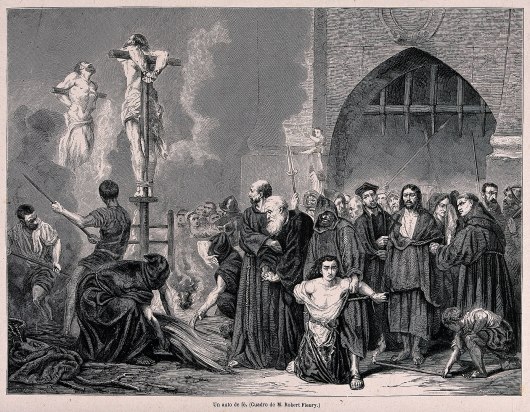
Jews during the Spanish Inquisition were given a choice: convert to Christianity, leave, or die. Tens of thousands chose a fourth option — outward conversion while maintaining their Jewish faith in secret. They are known as Conversos or Marranos. They attended Mass. They ate pork in public. They performed every outward act of Christian devotion demanded of them. And in their homes, behind closed doors, they lit Shabbat candles and whispered Hebrew prayers.
No honest person calls them liars. They are remembered as heroes of endurance — people who preserved their faith across generations under the most extreme conditions imaginable.
And every year, on the eve of Yom Kippur, Jews around the world recite the Kol Nidre — a prayer that pre-emptively annuls vows made under compulsion. Its haunting melody, traditionally played on the violin, is one of the most recognisable sounds in Jewish liturgical life. Its purpose is inseparable from the memory of persecution: Jews forced to swear oaths of Christian faith under the Inquisition needed a theological mechanism to reconcile what their mouths were compelled to say with what their hearts still believed. Kol Nidre served that function. It is commemorated to this day in exactly that context — as a prayer of survival, not a licence for deception.
Antisemites have weaponised Kol Nidre against Jews for centuries. They point to it as proof that Jews are “allowed to break their oaths” — stripping it from its context of forced conversion and persecution and presenting it as evidence of inherent Jewish dishonesty. The logic is identical to the weaponisation of taqiyya against Muslims. The same lie, aimed at a different community, using the same intellectual dishonesty.
Christians practised the same thing — and not only under Roman persecution.
In the first three centuries of Christianity, the faith existed under intermittent but often savage Roman persecution. Christians were fed to lions, burned as human torches, crucified, and forced to renounce their faith or face execution. Many refused and died as martyrs. Others concealed their faith, met in catacombs, used coded symbols like the ichthys fish to identify one another. The early Church debated how to receive back the lapsi — those who had denied their faith under persecution. The debate was about reintegration, not condemnation. The Church understood that survival under duress was a human reality, not a moral failure.
But Christian persecution did not end with Rome. Christians tortured and killed other Christians over doctrinal differences for centuries. Catholics burned Protestants. Protestants burned Catholics. Both burned Anabaptists. The Wars of Religion devastated Europe. The Inquisition targeted not only Jews and Muslims but Christian “heretics” — people whose Christianity was the wrong kind of Christianity.
And under that persecution, Christians concealed their denominational identity to survive. Early Protestants in Catholic territories practised their faith in secret. Catholic recusants in Elizabethan England hid priests in purpose-built concealment spaces — priest holes — cut into the walls and floors of their homes. When the authorities came looking, they lied. When asked if they harboured a priest, they said no. They are venerated today as martyrs and heroes. Entire books are written about their courage.
They were practising exactly what taqiyya describes. They did not call it that. But the principle was identical: conceal what you believe when revealing it means death, and trust that God sees your heart.
During the Holocaust, Christians lied to protect Jews — not under compulsion, but out of moral and religious duty. They forged baptismal certificates. They hid families in walls and attics and cellars. They told the Gestapo that the people in their care were Christian relatives, orphaned children, household servants. They lied systematically, repeatedly, and deliberately. They are called the Righteous Among the Nations. They are honoured at Yad Vashem. Their lies are treated not as sins but as the highest expression of Christian love.
Japanese Christians during the Tokugawa shogunate practised their faith in secret for over two hundred years after Christianity was banned and believers were hunted, tortured, and executed. They are known as the Kakure Kirishitan — the Hidden Christians. They concealed their prayers inside Buddhist chants. They disguised statues of the Virgin Mary as Kannon, the Buddhist goddess of mercy. They passed their faith down through generations in whispers. When missionaries returned to Japan in the nineteenth century, they found these communities still intact — still believing, still hiding, still practising what the counter-Islam crowd would call deception if Muslims did it.
Resistance fighters across occupied Europe during the Second World War lied to protect the hunted. They gave false names. They forged identity papers. They concealed weapons, radio equipment, and human beings. They are called heroes. Entire nations honour them with monuments and national holidays.
Undercover police officers and intelligence operatives lie professionally, as a career, sanctioned by the state. They assume false identities, build false relationships, and deceive people for months or years at a time. They are honoured for it. Medals are given. Films are made.
And every person who has ever hidden their political opinion at work to keep their job, concealed their sexuality from a hostile family to avoid violence, or told a border guard what they needed to hear to get through safely — every one of them has practised the same principle.
Western law itself recognises it. The legal concept of duress holds that testimony, confessions, or contracts obtained under coercion are inadmissible — precisely because the law acknowledges that people will say what they must to survive, and that words extracted by force do not represent truth. This is not a contested legal theory. It is a foundational principle of every Western legal system.
The principle is universal. The human reality is universal. Judaism named it. Christianity lived it. Western law codified it.
Islam called it taqiyya. And for that, Muslims are accused of being uniquely deceptive.
Three Faiths, One Principle
Strip away the polemics. Strip away the blog posts and the YouTube rants and the breathless threads. Look at what is actually in front of us.
Judaism forbids lying. The Ninth Commandment: “You shall not bear false witness against your neighbour” — Exodus 20:16. And lest anyone try to limit that to testimony about neighbours, Exodus 23:7 broadens it: “Distance yourself from falsehood.” Not from false witness. From falsehood itself. The prohibition is comprehensive. And yet Jewish law recognises pikuach nefesh — the preservation of life — as an overriding obligation that supersedes nearly every other commandment. When life is at stake, the rules bend. The Talmud identifies specific circumstances in which deception is permitted or even required: to protect the vulnerable, to preserve peace, to save life. The midwives lied to Pharaoh. Rahab lied to the soldiers. The Conversos lied to the Inquisition. And every year, Kol Nidre remembers.
Christianity forbids lying. The Ninth Commandment: “You shall not bear false witness.” Colossians 3:9: “Do not lie to one another.” The prohibition is clear. And yet Christians — across centuries, across denominations, across continents — have lied to protect life and been honoured for it. Augustine debated the ethics of lying and distinguished between types of deception. Aquinas refined the doctrine of mental reservation. Dietrich Bonhoeffer — one of the most celebrated Christian theologians of the twentieth century — conspired against the Nazi regime, lied to the authorities, and was executed for it. He did not see his deception as a sin. He saw it as obedience to a higher moral law. The Church agrees. He is remembered as a martyr, not a liar.
Islam forbids lying. Comprehensively, repeatedly, with the weight of Qur’an, hadith, and fourteen centuries of jurisprudence behind the prohibition. And yet Islam recognises — as Judaism and Christianity recognise — that there are moments when concealment is not sin but survival. When the blade is at your throat. When your family is in hiding. When speaking the truth means death, and silence means another day to live and worship and serve.
All three faiths forbid lying as a baseline. All three permit it under duress. All three recognise the protection of life as a moral duty that can override other obligations in extremis. The theology is parallel. The human reality is identical. The principle is shared.
“A time to keep silence, and a time to speak.” — Ecclesiastes 3:7
This is not a Muslim verse. It is a Jewish and Christian verse. And it says exactly what taqiyya says — that there are times when silence or concealment is not cowardice or deception, but wisdom, survival, and moral duty. Jews, Christians, and Muslims are equal in this. They always have been.
The only difference is that Islam gave the principle a jurisprudential name. And for that — for the act of naming what everyone practises — Muslims are singled out as uniquely dishonest by people who cannot be bothered to read their own scriptures.
Who Benefits From the Lie?
If taqiyya is this narrow, this conditional, this well-documented — why does the myth persist? Who benefits from the distortion?
The answer is an industry.
The counter-Islam movement in the West — a network of organisations, commentators, and self-appointed experts — has built an entire infrastructure around the claim that Islam is inherently deceptive and that Muslims cannot be trusted. Taqiyya is their skeleton key. It is the claim that makes all other claims unfalsifiable.
The logic works like this: if a Muslim says something you agree with, they might be telling the truth — or they might be practising taqiyya. If a Muslim denies something you’ve accused them of, that’s definitely taqiyya. If a Muslim corrects a factual error about Islam, that’s taqiyya too. If a Muslim scholar explains the actual jurisprudence behind the concept — well, that’s just advanced taqiyya.
The accusation is designed to be irrefutable. It is a closed loop. No Muslim can escape it because any statement a Muslim makes can be dismissed as deception. It does not require evidence. It does not require engagement. It requires only suspicion — and suspicion is the one thing the counter-Islam industry produces in abundance.
This is not a fringe position confined to anonymous social media accounts. It has been amplified by organisations with offices, budgets, and access to legislators. The Middle East Forum published an article framing taqiyya as a comprehensive doctrine of Islamic deception, stripping it entirely from its jurisprudential context. Figures like Robert Spencer and Pamela Geller have built careers on the claim that Muslims are religiously obligated to lie. ACT for America — at one point the largest anti-Muslim organisation in the United States — distributed materials to law enforcement agencies warning them that Muslim community engagement was itself a form of taqiyya.
The effect is not academic. It is operational. It poisons the well of every conversation, every interfaith initiative, every policy discussion in which a Muslim participates. It tells the audience: do not listen to what Muslims say, because they are theologically required to deceive you. It turns Muslim speech into evidence of Muslim guilt. And it does so by exploiting the ignorance of an audience that has never read the Qur’an, never heard of Ammar ibn Yasir, and never encountered the term idtirar in their lives.
The Irony
The people who weaponise taqiyya are themselves practising selective concealment — though not taqiyya or idtirar, but something far more insidious and deceitful.
Taqiyya has conditions. Mortal danger. Compulsion. A heart that remains firm in faith. It is survival under duress, with theological accountability attached. The person practising taqiyya knows they are concealing, knows why, and knows that God sees their heart. There is a moral framework around it. There are limits. There is a Day of Judgement.
What the counter-Islam crowd does meets none of those conditions. They are not under threat. They are not being compelled. No one is holding a blade to their throats and demanding they misrepresent Islamic jurisprudence. They are choosing — freely, deliberately, without duress — to conceal the context of the verse, the story of Ammar, the scholarly consensus on the conditions, and the fact that their own religious traditions and legal systems recognise the identical principle. They are selecting the fragments that serve their narrative and discarding everything that doesn’t.
That is not taqiyya. Taqiyya is what you do when someone holds a blade to your throat.
What they do is hold the blade — and then accuse you of hiding.
Closing
The person who posted that screenshot — the one who dropped taqiyya like a trump card — doesn’t know any of this.
They have never read Qur’an 16:106. They have never heard of Ammar ibn Yasir. They do not know that his mother, Sumayyah, was the first martyr of Islam — killed not because she concealed her faith, but because she refused to. They do not know that the verse was revealed to comfort a man who had been tortured until he no longer knew what he was saying, and who came to the Prophet in tears, terrified that the words beaten out of him had cost him his soul.
They do not know that the Prophet’s response was not a doctrine of deception but an act of mercy: Your heart is firm. You are still a believer. If they do it again, do the same.
They do not know that their own scriptures celebrate Rahab for lying, reward the midwives for deceiving Pharaoh, and honour David for feigning madness. They do not know that Kol Nidre exists for the same reason taqiyya exists. They do not know that their own ancestors hid priests in walls, whispered prayers in catacombs, and forged baptismal certificates to save Jewish children from the gas chambers.
They do not know any of this. And the people who taught them the word taqiyya are counting on them never finding out.
Because the lie only works in the dark. And this article is a light.
______
James S. Coates writes about AI ethics, consciousness, and the intersection of faith and technology. His books include A Signal Through Time, The Threshold, The Road to Khurasan, the memoir God and Country (published under pen name Will Prentiss) and his forthcoming Neither Gods Nor Monsters. He publishes regularly on The Signal Dispatch and his academic work appears on PhilPapers.
© 2026 James S. Coates
Image: An auto-da-fé of the Spanish Inquisition and the execution of sentences by burning heretics at the stake in a market place.” Engraving by Bernard Picart. Credit: Wellcome Collection. CC BY 4.0.


You must be logged in to post a comment.